Author: gortoner

This is Haiti: culture shock part two

After a week of elevated alcohol levels and little sleep to be found between late nights and the noisy fellow occupants of our 12-bed dorm room, I’m not in the best state of mind as we leave Miami. After being let down by extremely unreliable friends and Wi-Fi networks, I spent the final evening drinking alone in a bar, indulging a hormone-induced self-pity. Luckily I made friends with the barman who delighted in calling me Emily Rose in a carrying voice and topping up my glass. He was appalled at the very idea of a hostel and offered for me to stay with him when I next come to the city. Our flight is early the next morning, which gives me just three hours to struggle with sleep beneath our ferocious air conditioning before I’m released by my alarm and we head to the airport. I spend the journey semi-conscious, waking only to perform the tedious procedures demanded of me by airport staff, largely oblivious to my surroundings. I didn’t really know what to expect …

Welcome to Miami: stop-over culture shock

What little time we have left in Guatemala we spend in Antigua, a town further south and convenient for the airport, mainly working in the numerous quaint cafés of its touristy square. The city, reminiscent in many ways of San Cristobal in Mexico, sits in the shadow of a volcano which rises symmetrically and dizzyingly above us. Even after two days it’s still captivating as I sit on the roof of our hostel, staring at the mists that lap around it’s far summit, my laptop sleeping beneath my slack fingers. A little later that evening, a neighbouring volcano erupts, spilling lava into the night to dribble down its banks and paint red streaks in our horizon – the country’s parting gift. The journey to Guatemala City airport is relatively painless and hassle free considering the notoriety of the capital, its reputation for danger the very reason we stayed in Antigua to begin with. Through security now and closeted in the safe vacuum of air transit, my focus turns to our next and in many ways …

A lesson in politics: empowering children to influence in Xela

I have a very vivid memory of my first conversation about politics. I must have been pretty young, as me and my brother were in our old house in Kilburn and still sleeping in bunk beds. It must have been around a significant election – probably 1997 – and he spoke to me into the forbidden hours after bedtime about the whole concept of government, the different parties and why it was an important day for the country. I don’t think my parents would have overheard this midnight lesson, as I’ve since discovered they were absorbed in celebrating the glorious culling of a much hated Tory cabinet. My interest in politics didn’t grow much beyond this basic understanding until I reached sixteen and my A Level in the subject. Even this was very much about learning the systems, the history and the processes of politics. We rarely looked at current issues or held debates where our views could be encouraged and examined. It was only university that helped me to think in a more independent …

Driving through Guatemala: border crossings and a market

Our first few days in Guatemala are taken up almost entirely by two complicated and seemingly endless journeys, their length altogether inexplicable for the distances covered. But the densely jungled round-topped mountains and the occasional volcanoes of the new country are all the entertainment we could ask for as we speed along the meandering roads and away from the security of Junax, San Cristóbal and Mexico. I’ve reached that blissful level of tolerance known only to long-term travellers, where sleep is easily accessible and impenetrable when found, despite noise or motion. Any surface suffices a pillow and the observation of passing scenery is all that’s needed for occupation. On this first day, driving across the border to Quetzaltenango where we’ll find our next project, I spend those first two hours in a watchful meditation, resurfacing only to adjust the soundtrack humming companionably from my headphones. Our party, which we collected from different corners of San Cristóbal at our early departure time, is international, and my interest drifts occasionally into the strange collection of different languages …

The nomads of Mexico: how to afford a life of travel

How can people afford to spend their lives travelling? It’s a question I’ve been asking ever since I experienced my first months’ backpacking and the wonderful, heightened state of existence they allowed me to access. Even now, out in the world again with my life on my back, the question is ever-present, seductive and unanswerable: how can I sustain this? It was only when I found myself staying at Junax, a small hostel in San Cristóbal Mexico exclusively for volunteers, that I began to understand how it could be done. There we found a very different kind of traveler – the kind you need to become to make travel a sustainable lifestyle. These were people staying in the city for long periods of time and working with charities, some of these placements arranged by the owner of the hostel herself. Most were also working on their own side projects – one author, a couple of PHD students – and this hostel, deliberately low cost to encourage volunteers, made a long-term stay more than affordable. Combine …

Lost in translation: linguistic challenges in Chiapas

A definition of intelligence: the ability to adapt quickly to new environments. I have never felt less adequate of this definition than last weekend as I sat for an hour in meditative silence beneath the impenetrable Spanish of my five new Mexican companions. Despite spending around £600 and at least five hours each week on my language learning effort to prepare for this trip, my Spanish level is still little more than inebriated toddler. And that’s when I can work up the courage to speak. Early last week in one of my rare moments of bravery I wandered into a torillaria in the beautiful city San Cristóbal where we’ve been helping our latest project. I wanted to establish whether they made tortillas with corn or flour, and therefore if I could eat them. My questions were met with amused bafflement and I ended up abandoning the mission and leaving the shop empty handed. Elliott turned to me wearily and asked if I wanted him to try. He returned with a stack of tortillas and the …

Giving working children the tools to protest: fighting for human rights in San Cristóbal

The children in Chiapas seem a lot older than normal children. They already have the weary weight of responsibility in their eyes. From as young as three they wander the streets of San Cristóbal till the early hours, selling bracelets and flowers and any number of miscellaneous objects. One girl heads straight for me in the wine bar where I sit with the evidence of privilege spread around me; my digital appliances charging on the table, my Harris Tweed wallet, my resounding European laugh. She must be about six years old. She can smell my oestrogen levels from the other end of the street and uses just one calculated expression to send me into broody fits of moisten-eyed sympathy. “Una Tortuga. Diez pesos,” she says – that’s about 40p. It’s very difficult to resist as she lines up her selection of little clay animals on the table, and I do buy the tortoise first presented to me. I even exclaim childishly, “dos tortugas!” pointing out the second small tortoise on the back of the first. …

Disorientation: our arrival in San Cristóbal de Las Casas

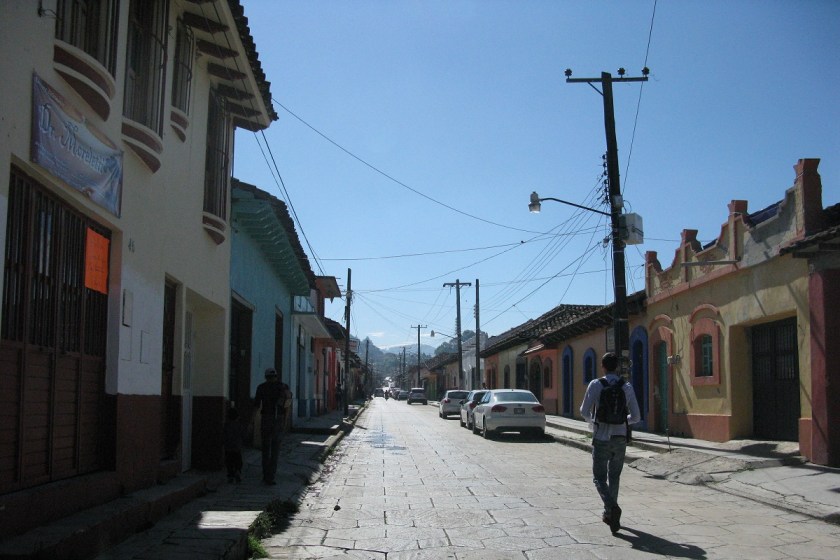
A bewildering fourteen-hour overnight bus journey takes us far from the relentless bustle of Mexico City and into the tranquillity of San Cristóbal de Las Casas, high in the mountains. Cars wait in lines to greet us, adorned with bunting and bright balloons. The sun extends their colours to dance in arcs through the clear air. Uplifted by this exquisite welcome, we stumble into a taxi and watch the sleepy streets pass. We’re staying at the artisan’s commune Kza Libertad, the House of Liberty, on the recommendation of a volunteer on our second project, and approach it with more than a little apprehension. We find a ramshackle and not altogether structurally sound building with hammocks in the open courtyard, friendly dogs and a bleary-eyed household, whether from the morning or the smell of marijuana permeating every wall and fabric, it’s difficult to tell. We drop our bags and leave for a more appropriate moment to explore our living quarters. San Cristóbal is just waking up. After some negotiation with the unfamiliar roads, their colourful houses, …

The gift of English: inspiring teens through teaching

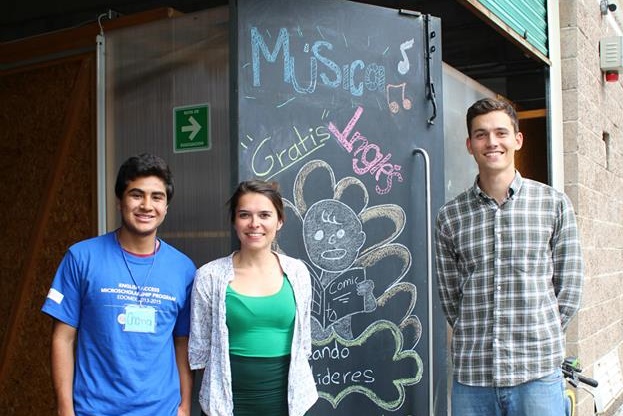
We’re so very fortunate in the UK to be handed the shining gift of the English language from our early years. This advantage has never been more evident as I’m introduced to Chema, a young teen who’s just finished a two year English course at one of Fundación Proaccesso’s community learning centres on the outskirts of Mexico City. His proud teacher Hector has pulled him into our intimidating presence, and nods encouragement as Chema self-consciously joins our conversation in the new language.  To him, he explains, English has been life-changing. It opens up so many opportunities for his future. Such has been his experience on the course and the understanding of the opportunities English can create, it’s inspired him to teach, joining with four other students to lead summer classes in English and a variety of other subjects to kids in the community. Completely voluntarily. We watch him return to the classroom where the first lesson of this course is being taught and already sounds like a riotous success. Hector is visibly moved. He explains …